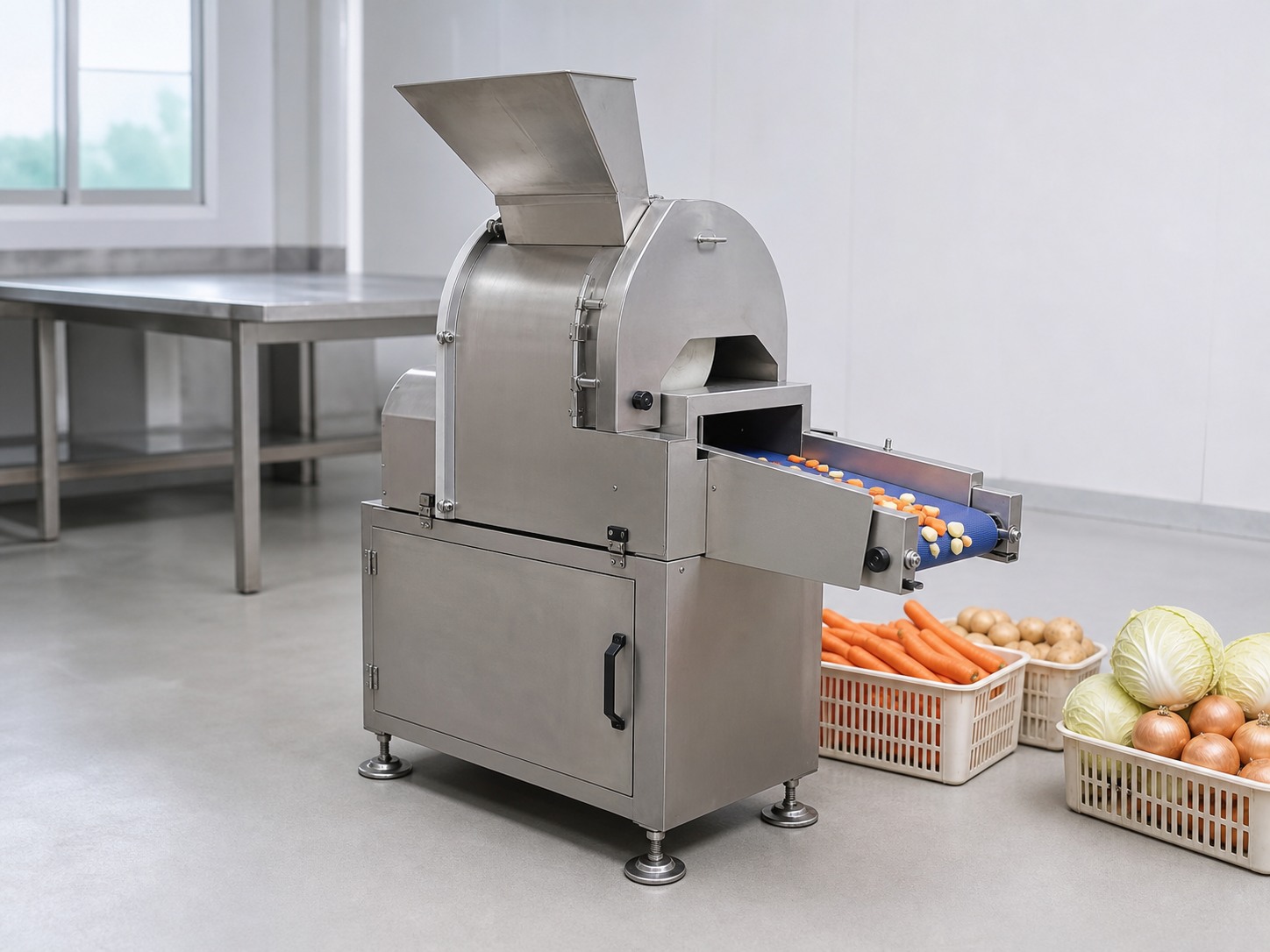
Commercial Vegetable Cutting Machine for Slicing, Shredding and Dicing
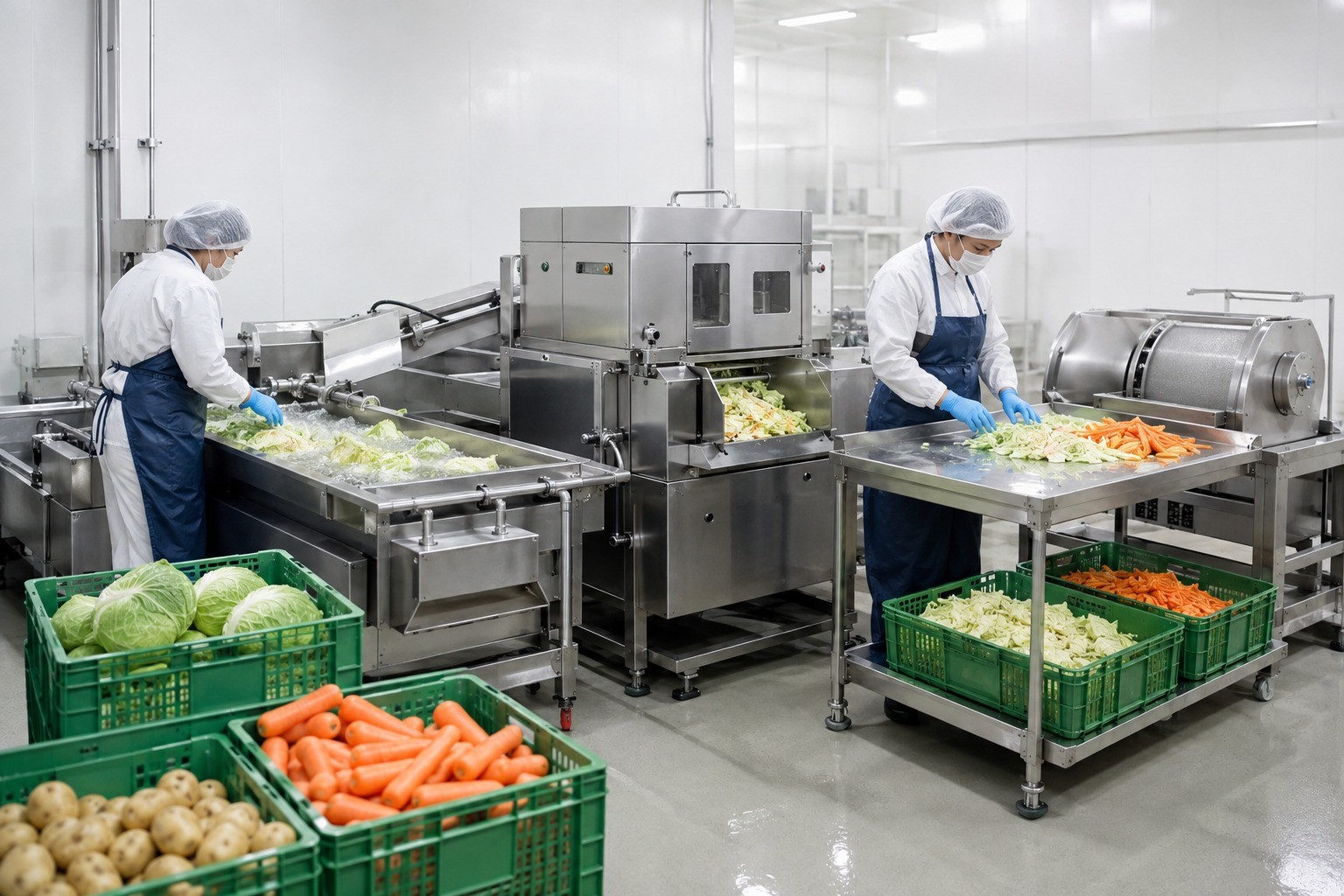
When a prep room is still relying on hand knives, the real cost is not only labor. Uneven pieces cook, blanch, freeze and dry at different rates, while frequent product changes make each shift harder to plan. An AGICO commercial vegetable cutting machine gives processors a controlled way to produce slices, strips, shreds or cubes at repeatable sizes. It can work as a stand-alone machine in a central kitchen or become the cutting station between a fruit and vegetable washing machine and downstream blanching, drying, freezing or packing equipment.
The right configuration depends on the vegetable, its firmness, the required shape and the condition in which it reaches the knife. Cabbage and leafy vegetables need a different feeding action from potatoes, carrots or onions. That is why we begin with product samples and the buyer's finished-cut specification, then match the feed opening, blade assembly, belt speed and discharge height to the actual job.
A Practical AGICO Cutting Solution, Not a One-Size-Fits-All Machine
Anyang General International Co., Ltd. (AGICO) has more than 20 years of experience supplying fruit and food processing machinery. For a vegetable cutter, our job is to look beyond the catalogue name. We ask what goes into the machine, what must come out, how many kilograms the line must handle per hour, and how quickly operators need to change products or wash the cutting chamber. This application-first approach helps buyers avoid paying for unnecessary complexity while leaving enough capacity for the next stage of growth.
Why Processors Choose a Commercial Vegetable Cutter
One Machine, Several Marketable Cut Styles
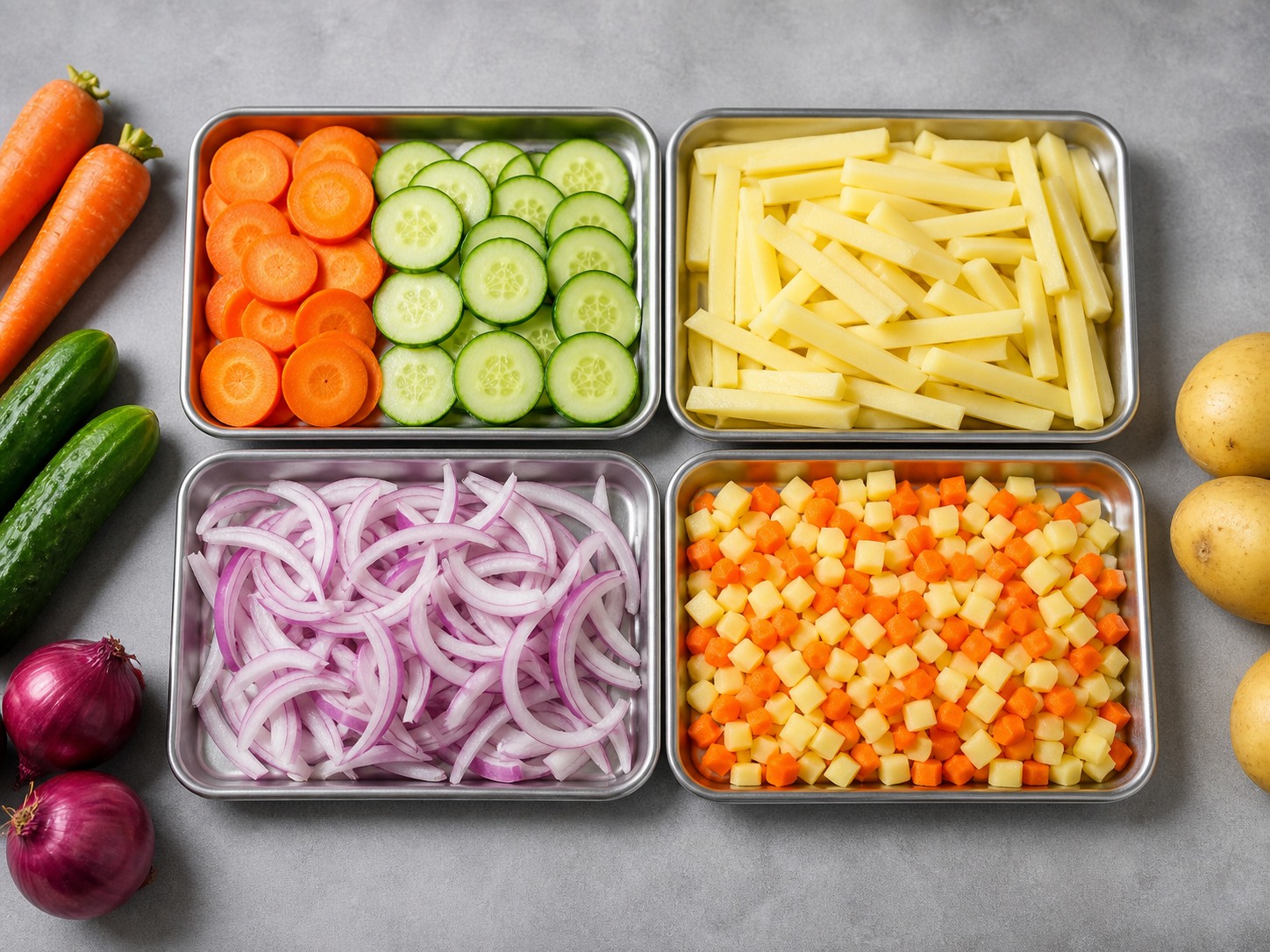
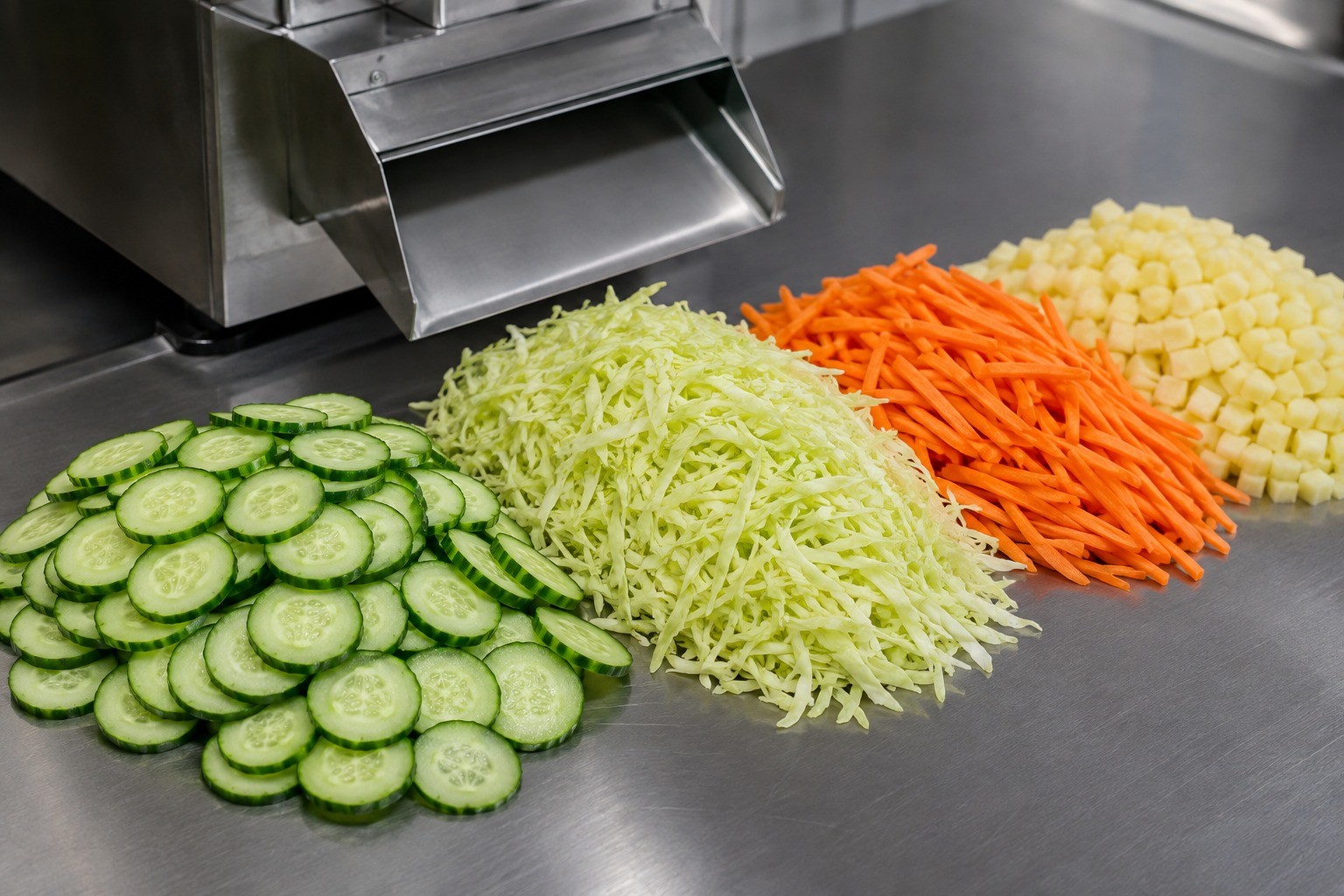
Interchangeable knife sets let one platform handle several sales formats. A processor may produce cabbage shreds in the morning, onion strips after lunch and diced carrots for a frozen mix at the end of the shift. The final scope can include slicing discs, strip-cutting knives, dicing grids or wave-cut options, subject to the selected machine and raw material test.
More Consistent Pieces and More Predictable Downstream Results
Uniform cut size is a process-control tool. Similar pieces receive more even heat transfer in blanching and frying, lose moisture at a more consistent rate in drying, and present a cleaner appearance in retail packs. Stable dimensions can also make portion control and filling weights easier to manage. Results depend on vegetable variety, maturity, temperature and feed preparation, so sample trials remain important.
Built Around Hygiene and Fast Changeovers
Food-contact areas can be specified in stainless steel, with smooth surfaces, removable cutters and accessible cleaning points. A guarded cutting chamber, interlocked cover options and an emergency stop support safer daily operation. The exact safety circuit and electrical components are confirmed for the destination market and the agreed configuration.
A Compact Step Toward Higher Throughput
Automating the most repetitive cutting task reduces dependence on individual knife skills and makes output easier to schedule. A compact cutter can be the first upgrade for a growing kitchen, while a conveyor-fed model can keep pace with continuous washing and inspection. The commercial gain is not an abstract efficiency claim: it is the ability to accept larger orders with more consistent presentation and fewer cutting bottlenecks.
How the Vegetable Cutting Machine Works
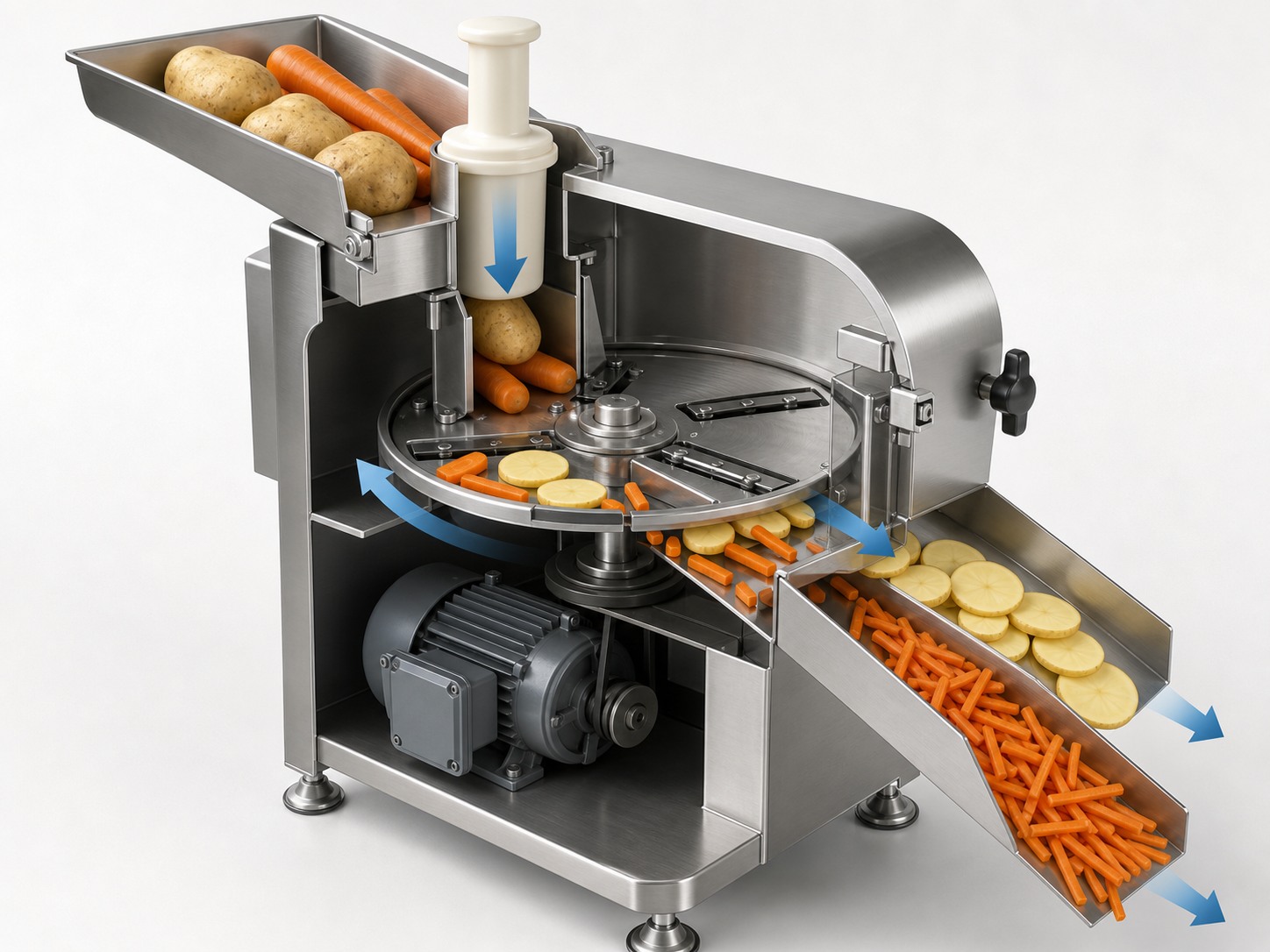
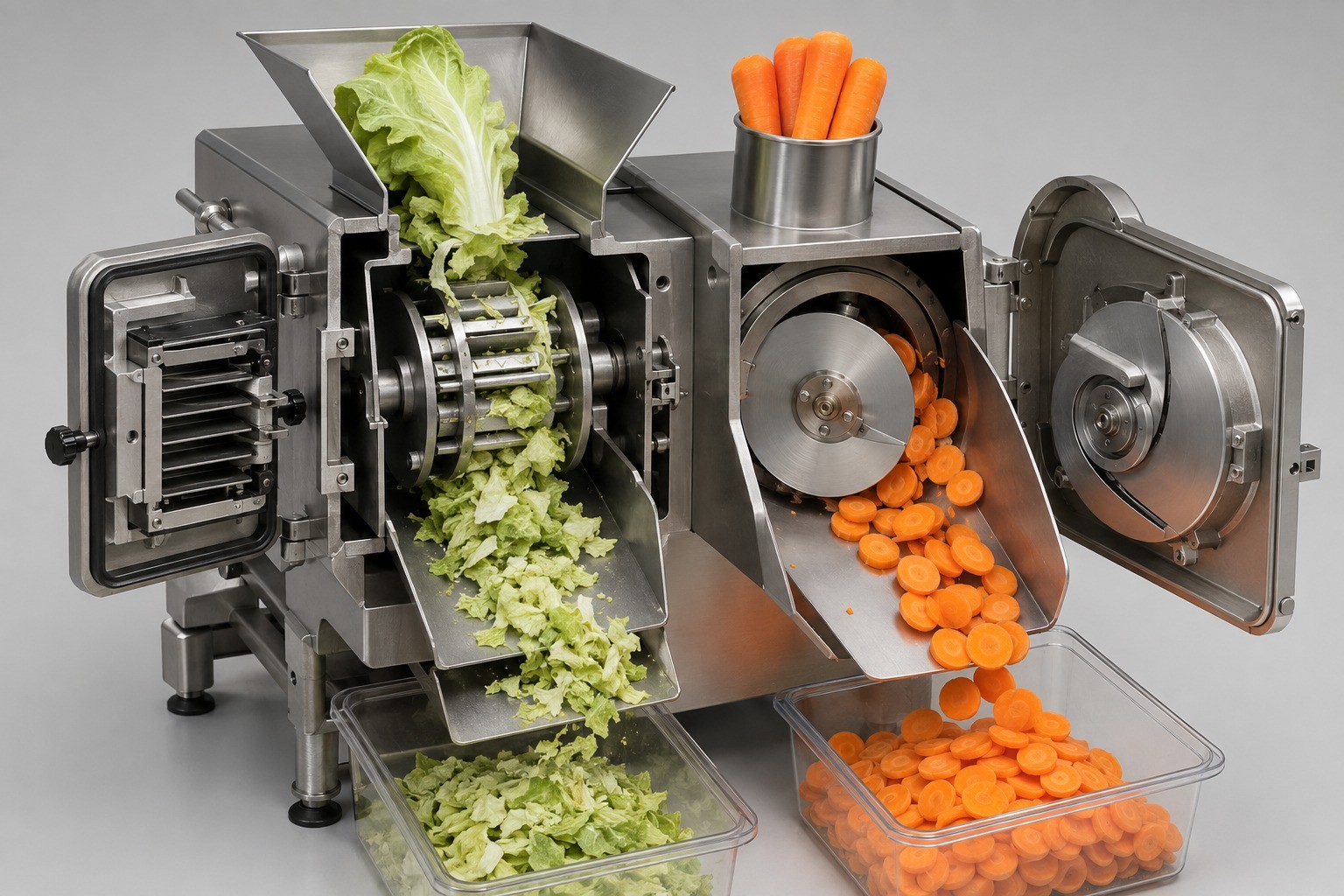
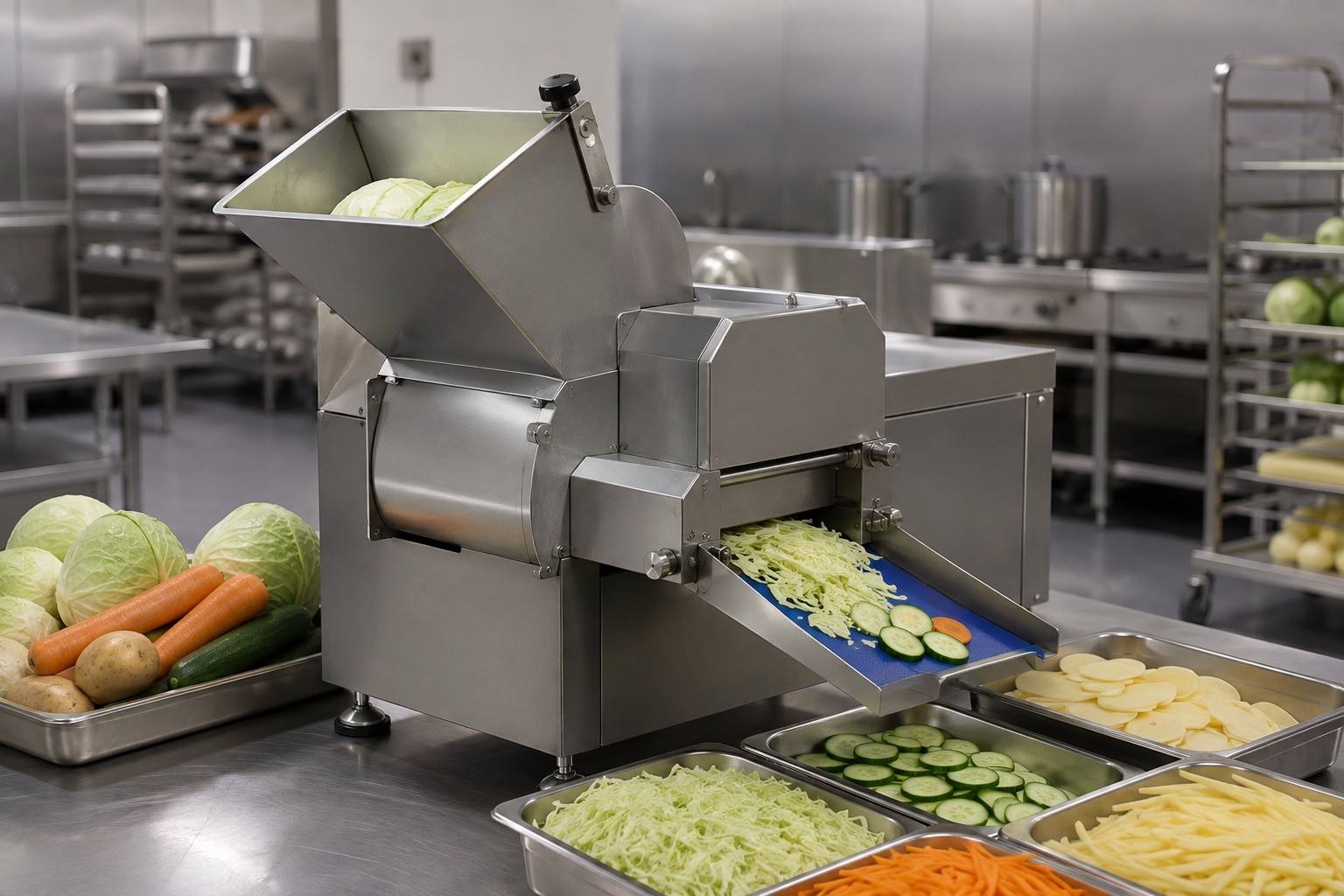
Prepared vegetables enter through a feed chute or conveyor. A pusher, belt or gravity feed presents them to the selected knife assembly. Depending on the required result, a rotating disc may create slices, a straight-knife system may cut leafy vegetables to length, or a compound knife set may form strips and cubes in one pass. The product then leaves through a guarded discharge chute or conveyor for inspection and the next operation.
Cut quality starts before the blade. Oversized produce may need trimming, root vegetables should be washed and peeled as required, and slippery or soft materials may need a dedicated feed arrangement. Blade sharpness, feed pressure and machine speed must be matched rather than simply turned to the highest setting. This protects the cut surface and reduces broken pieces.
Vegetables, Products and Cut Formats
Central Kitchens and Fresh-Cut Operations
Prepare cabbage, lettuce, celery, onions, carrots, cucumbers and other ingredients for meal kits, restaurants, institutional catering and ready-to-cook packs. Quick blade changes are especially valuable where recipes change through the day.
Frozen and Dehydrated Vegetable Plants
Produce controlled dices, strips and slices before a food blancher, freezer or mesh-belt dryer. Consistent geometry helps operators establish repeatable blanching and drying settings, although each product still requires its own process validation.
Snack and Potato Processing
Cut potatoes and other firm roots for downstream washing, frying and seasoning. Buyers focused only on thin potato slices should also review the existing banana chips slicing machine for a simpler slicing reference, while a complete potato chips production line is more suitable when washing, peeling, blanching, frying, deoiling and seasoning must be supplied together.
Pickles, Salads and Ingredient Preparation
Slice cucumbers and onions, shred cabbage, or dice carrots and potatoes for pickles, salads, soup ingredients and sauce preparation. For fragile, hollow or very soft produce, tell us the product condition and target appearance so the feeding and knife system can be evaluated before quotation.
The following figures are preliminary reference configurations derived from common industry arrangements. They are not binding AGICO guarantees. Final capacity, dimensions, power, cut range, voltage, blade set and material certificate will be confirmed after sample and line review.
Reference model*
Best-fit duty
Preliminary capacity
Cut range
Motor power
Approx. dimensions
VC-500
Slicing / shredding
500-800 kg/h
1-5 mm
0.75 kW
700 x 500 x 850 mm
VC-600
Root vegetables
300-600 kg/h
Slices / strips
0.75 kW
600 x 500 x 900 mm
VC-1000
Dicing
600-1,000 kg/h
3-25 mm cubes
0.75 kW
670 x 420 x 900 mm
VC-2000
Multi-function line
1,500-2,000 kg/h
Project-specific
0.75 / 1.5 kW
1,300 x 770 x 890 mm
*Preliminary reference models only. Actual performance varies with vegetable type, size, moisture, pre-trimming, feed continuity and required cut quality. Request a written technical proposal before using these values for plant design or purchasing commitments.
How to Select the Right Cutter
01
Send the raw material list. Include variety, typical dimensions, firmness, temperature and whether the product is whole, peeled or pre-trimmed.
02
Define the finished cut. State slice thickness, strip cross-section, cube size or shred length, preferably with a photo or physical sample.
03
Set the real throughput target. Share average and peak kg/h, shift length and the capacity of the next machine. Oversizing the cutter can simply move the bottleneck downstream.
04
Confirm utilities and integration. Provide voltage, frequency, workshop layout, feeding height, discharge height and whether conveyors or a wash line are already installed.
05
Agree on cleaning and changeover needs. List allergen-control requirements, cleaning frequency and how often the product or cut format changes.
Commercial Cutter vs. Manual and Single-Purpose Cutting
Decision factor
Manual cutting
Single-purpose cutter
Configured commercial cutter
Output consistency
Operator-dependent
Good for one shape
Repeatable across selected knife sets
Labor requirement
High
Lower
Lower and easier to schedule
Product flexibility
Very high but slow
Limited
Slices, strips, shreds or cubes by configuration
Best fit
Very small batches
One stable SKU
Growing multi-product production
Key trade-off
Speed and consistency
Limited future use
Needs correct setup and cleaning discipline
A multi-function machine is not automatically the best answer. If one factory runs a single high-volume cut all year, a dedicated cutter may be simpler to clean and optimize. If product mix changes frequently, the time saved by modular knives and repeatable settings can outweigh the extra configuration cost. AGICO can compare both approaches against the buyer's production plan.
From Stand-Alone Machine to Complete Vegetable Preparation Line
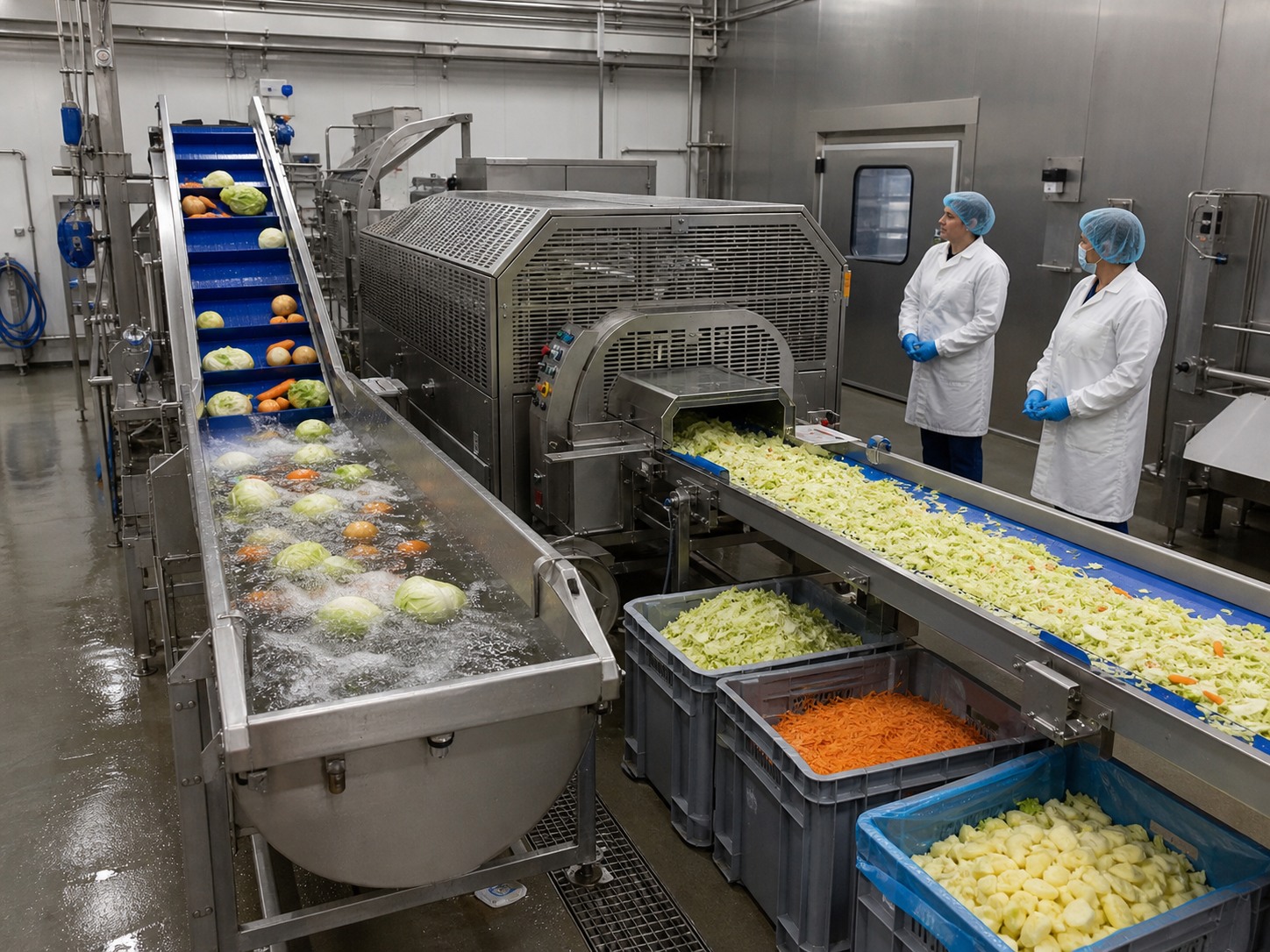
A typical preparation flow is sorting and trimming, washing, peeling where required, cutting, secondary washing or starch removal, blanching or treatment, dewatering, freezing/drying/frying, and packing. Not every product needs every stage. We can supply a stand-alone cutter, arrange matching conveyors, or help define a complete line around the target product and finished package.
For clean-vegetable projects, we pay particular attention to transfer height, belt width and surge capacity. Smooth handoffs prevent vegetables from collecting between machines, while accessible conveyors make inspection and sanitation easier. A layout drawing and sample test should be approved before fabrication of a connected line.
Service Across the Equipment Lifecycle
Before purchase: application review, cut-sample discussion, preliminary layout, utility confirmation and a clear scope of supply.
Before shipment: inspection against the agreed configuration, operating documentation and packing suitable for the delivery method.
During start-up: installation and commissioning guidance according to the contract, plus operator instruction for blade changes, safe feeding and cleaning.
After start-up: troubleshooting support and supply planning for knives, wear parts and other agreed spares.
Responsible Operation and Waste Reduction
A well-selected cutter can reduce off-size pieces and help processors recover more saleable product from each batch. Sharp, correctly matched knives also avoid crushing that creates excess fines or juice loss. Energy use is modest compared with thermal processing, but the practical sustainability gains come from better yield, sensible motor sizing, planned maintenance and a washable design that does not require excessive cleaning time or water. Actual yield and resource savings should be measured on the buyer's product rather than assumed from catalogue claims.
Food-Contact Quality and Safety Approach
The offered machine can be configured with stainless-steel food-contact surfaces, guarded moving parts and electrical components selected for the destination. Before order confirmation, the technical agreement should identify the steel grade, surface finish, knife material, motor and control brands, protection level, electrical standard and required documentation. CE, HACCP, UL or other compliance should only be stated when it is included in the specific order and supported by the corresponding documents.
Daily safety still depends on disciplined use. Operators should never reach into a feed chute, defeat an interlock or clean the machine while power is connected. A lockout procedure, cut-resistant handling practices for loose blades, inspection of fasteners and replacement of damaged guards should be part of the site's operating procedure.
Tell Us What You Need to Cut
A useful quotation begins with the product, the cut and the hourly target. Contact AGICO with your vegetable list, sample photos, desired dimensions and utility details. We will recommend a stand-alone vegetable cutting machine or a connected preparation solution, clarify the preliminary parameters, and help you build a scope that can be compared line by line before you invest.
A:Common applications include potatoes, carrots, onions, cabbage, cucumber, celery, eggplant, taro, sweet potato, bamboo shoots and similar produce. A material test is recommended for soft, fibrous, hollow, slippery or irregular products.
Q:Can one machine make slices, strips and cubes?▼
A:Yes, when the selected platform supports interchangeable knife sets. Some shapes require a dedicated feed or compound knife assembly, so the exact list of outputs must be written into the technical proposal.
Q:How do I choose the right capacity?▼
A:Base the selection on usable output, not only feed rate. Allow for trimming, loading gaps, product changes and cleaning. The downstream washer, blancher, fryer, dryer or packer should be able to accept the cutter's peak discharge without creating a queue.
Q:Will the cut size be adjustable?▼
A:Adjustment may be made by changing blade spacing, replacing a disc or grid, or altering belt and knife speed, depending on the machine. Tell us the acceptable size tolerance and all required formats before quotation.
Q:How is the machine cleaned?▼
A:After safe isolation, operators remove product residues and clean accessible food-contact areas, knives, guards and discharge parts according to the manual. Removable knife sets and open access reduce changeover time. The final cleaning method depends on the supplied electrical protection and sanitation design.
Q:Can it connect to an existing line?▼
A:Usually yes. We need the existing conveyor width, line speed, feeding and discharge heights, workshop drawing, power supply and target control interface. A buffer conveyor may be useful when upstream flow is uneven.
Q:What information is needed for a price?▼
A:Send the vegetables, finished cut sizes, required kg/h, voltage and frequency, working hours, preferred automation level, destination country and any food-contact or compliance requirements. Photos or a short video of the raw material make the recommendation more accurate.